18.12.13

Sampling campaign the Cabrera Archipelago

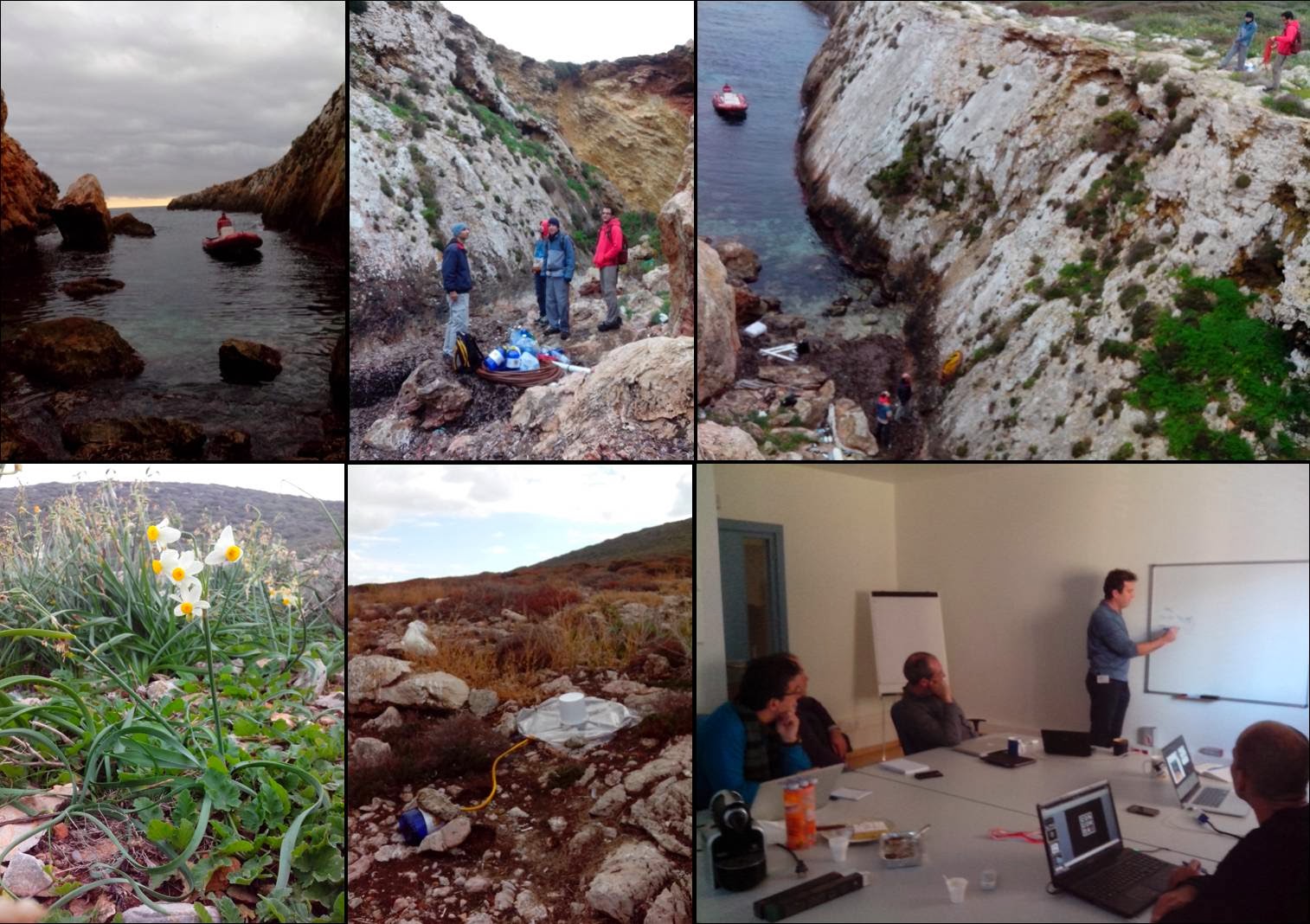
Last week, we joined other members of the Concorda project and sailed into Conillera ("Rabbit Island") to install 55 collectors of seabird guano.

The visit, during which samples of atmospheric deposition from a collector placed at neighboring Cabrera Island were also taken, was a (long-awaited) success: Conillera has no harbour, so we needed almost perfect sea conditions to be able to jump into the rocky shores. Rough terrein demanded also the use of ropes to disembarck the material, and made the transport and installation of the collectors challenging. But we had a perfect winter day, cold and sunny, and enjoyed the exhuberant autumn bloom of local daffodils Narcissus tazzeta.

Two days later, we had the second annual meeting of the Concorda Project - a great opportunity to learn from the diverse expertise of its multidisciplinar consortium.

1.12.13

LSE moves to Sevilla and becomes SEG

Last October 15th, the Laboratory of Spatial Ecology moved to the Doñana Biological Station (EBD-CSIC) at Sevilla (SW Spain), and became the Spatial Ecology Group - which is part of the Department of Wetland Ecology.

We celebrated the move with  a barbecue, where preeminent researchers from EBD showed that they can also do reasonable soccer; and a morning of birdwatching in the marismas -where we enjoyed recently-arrived geese, cranes, waders, resident flamingoes, raptors, and our all-times favourite: ducks.

For a few months, we will be finishing-off existing work projects at Mallorca - and part of the Group's personnel will be based there. And we hope to continue our collaborations with former colleagues at IMEDEA for years to come.


Farewell Mallorca, which was a great place to be and do research - and welcome Sevilla, which will hopefully meet our high expectations!

21.10.13

Edge effects in a 3D world

The last paper of Ainoha Magrach's PhD is finally on print.

This apparently simple piece of work involved measuring seed germination and occurence of epiphytes up to 12 m in the canopy, an incredibly challenging task in the dense and rough forests of Chiloé (the image on the left is taken at the verge of an illegal-logging gap, the only way to get a good view of tree sizes).

A. Magrach, L. Santamaría, A.R. Larrinaga (2013) Edge effects in a three-dimensional world: height in the canopy modulates edge effects on the epiphyte Sarmienta repens (Gesneriaceae). Plant Ecology 214: 965-973.

After working at James Cook University in Cairns, Australia, Ainhoa has joined now the Ecosystem Management group at ETH in Zurich.


9.10.13

Lucía Latorre obtains her PhD, publishes a new paper and sets off to a conservation job in the Seychelles

Last week, Lucía Latorre defended her PhD thesis at the University of Santiago de Compostela.

In her thesis, entitled "Biological invasions on islands: dynamics, impacts and management", she studied a number of invasion complexes of increasing complexity (from black rats at Dragonera Islet, E Spain, to minks, cats, rats and rabbits at Cíes Islands, NW Spain) to derive suitable management strategies focused on impact minimisation.

It was an intense week for her. A few days earlier, she got her third paper published in PLoS One:

Latorre, L., Larrinaga, A.R., Santamaría, L. 2013. Rats and Seabirds: Effects of Egg Size on Predation Risk and the Potential of Conditioned Taste Aversion as a Mitigation Method. PLoS ONE 8(9): e76138

And a few days later, she jumped on a plain to start a new position as Invasive Species Project Officer of the Seychelles Islands Foundation, on the island of Praslin. Invasive plants: beware!

Congratulations to Lucía. She made us proud and will surely continue doing so.

Update: Lucía's PhD Thesis hit the local news. Have a look at the article "The less known enemies of Cíes Islands" (in Spanish) here.

22.7.13

Second field campaign of the PARIS project in Mallorca

During the first half of July, we completed the second field campaign of project PARIS, a collaborative undertaking of the teams led by Elena Gómez Díaz at IBE-CSIC, Jordi Figuerola at EBD-CSIC and Luis Santamaría at IMEDEA-CSIC (this lab) to study the endoparasites of the two species of Balearic wall lizards (Podarcis lilfordi and P. pityusensis).

This campaign focused on resampling two populations of Lilford's wall lizard, at Sa Dragonera y Cabrera, and one invasive population of Ibiza wall lizard, at Illetes (Mallorca).

The campaign's team included Raquel Vasconcelos (IBE), Asier R. Larrinaga (LSE-IMEDEA) and several students of Biology and Biochemistry at the University of Balearic Islands (UIB): Valero Andreu, Alina Chalenko, Miriam Viader and Nahuel Manzanaro. Despite the high temperatures (we sampled during a severe heatwave) and the intensive work, the beauty of the field sites and the good humour of the team made the campaign a memorable experience.

13.6.13

Spanish R&D in Science Policy Forum


The article Dark Clouds over Spanish Science, which addresses the Spanish R&D policy, came out today in Science Policy Forum. It is a small contribution to improve the analysis of the productivity and quality of Spain's research and innovation systems.
A number of media are commenting on the paper, such as:
- Contra la ciencia orientada al sector privado, at El País
- 'Science' ve 'nubarrones' sobre la ciencia española, at El Mundo
 - La revista ‘Science’ critica el giro de España hacia la investigación “de mercado”, at Es Materia

- Science se hace eco de las "nubes negras" sobre la ciencia española, at ABC.

There are more details on the implications in these two interviews (both in Spanish):

- La Tertulia de Luis Herrero, esRadio, minutes18:22 to 27:13

- Balears fa Ciència, IB3, minutes 09:25 to 20:02

You can find more details on the devastating budget cuts suffered by Spain's R&D during the last years in this post of the blog ""Critical Science" (in Spanish).