23.4.14

Long distance dispersal by migratory birds

Next Monday 28th 2014, at 11:00, Duarte Viana will defend his PhD Thesis at the Universidad Pablo de Olavide (Sevilla).

Duarte is a member of Jordi Figuerola's Group at EBD. His thesis focuses on the long-distance dispersal of plant seeds and animal resting eggs by migratory birds, and includes:
- 1D models of propagule dispersal by migratory birds
- an observational experiment testing for the actual occurrence of seeds in the guts of birds engaged in migratory flights
- the results of a continental-wide survey of aquatic biodiversity
- a manipulative experiment testing the role plaid by two components of biotic resistance (diversity resistance and priority effects) during the (re)colonization of Doñana's temporary ponds.

If you are around Sevilla next Monday, don't miss it. If not, you can check the two modelling papers in AmNat and Ecography - and keep posted for an update on the publication of chapters currently under review.

21.4.14

Metaanalysis on the effects of forest fragmentation on species interactions


A team of four led by Ainhoa Magrach, a former SEG PhD-er  now based at ETH Zürich, uses meta-analytical techniques to evaluate whether mutualisms are more sensitive than antagonisms to the negative effects of forest fragmentation.

The paper is on early view in Conservation Biology:

Meta-Analysis of the Effects of Forest Fragmentation on Interspecific Interactions


26.1.14

Sampling Phoenicean Juniper in Cabrera Island

Last week, a team of six researchers undertook the main field activity of project Gensabina in the 2013-14 wintering season: sampling the gentic structure of a population of Phoenicean Juniper (Juniperus phoenicea) in Cabrera Island.

The work took place at Cala Santa María, one of the most isolated Juniper populations present on the island. It  involved accurate geo-referencing and sampling >1,100 junipers of different life stages (from saplings to reproductive adults), a challenging task given rough slopes were they grow - as you may appreciate in some of the pictures.

The sampling team included three members of Gensabina: Carles Molina (who joined us as field and lab technician last October: welcome!), Pablo Guitian (USC) and Luis Santamría (EBD); and three Master students of the Anglia Ruskin University: Sarah J. Evans, Suzanne Makki and Martina J. Bristow.  It was a week of intense work but, despite a couple of days of heavy wind, we were able to enjoy Cabrera's sunny weather and awsome landscapes.

18.12.13

Sampling campaign the Cabrera Archipelago

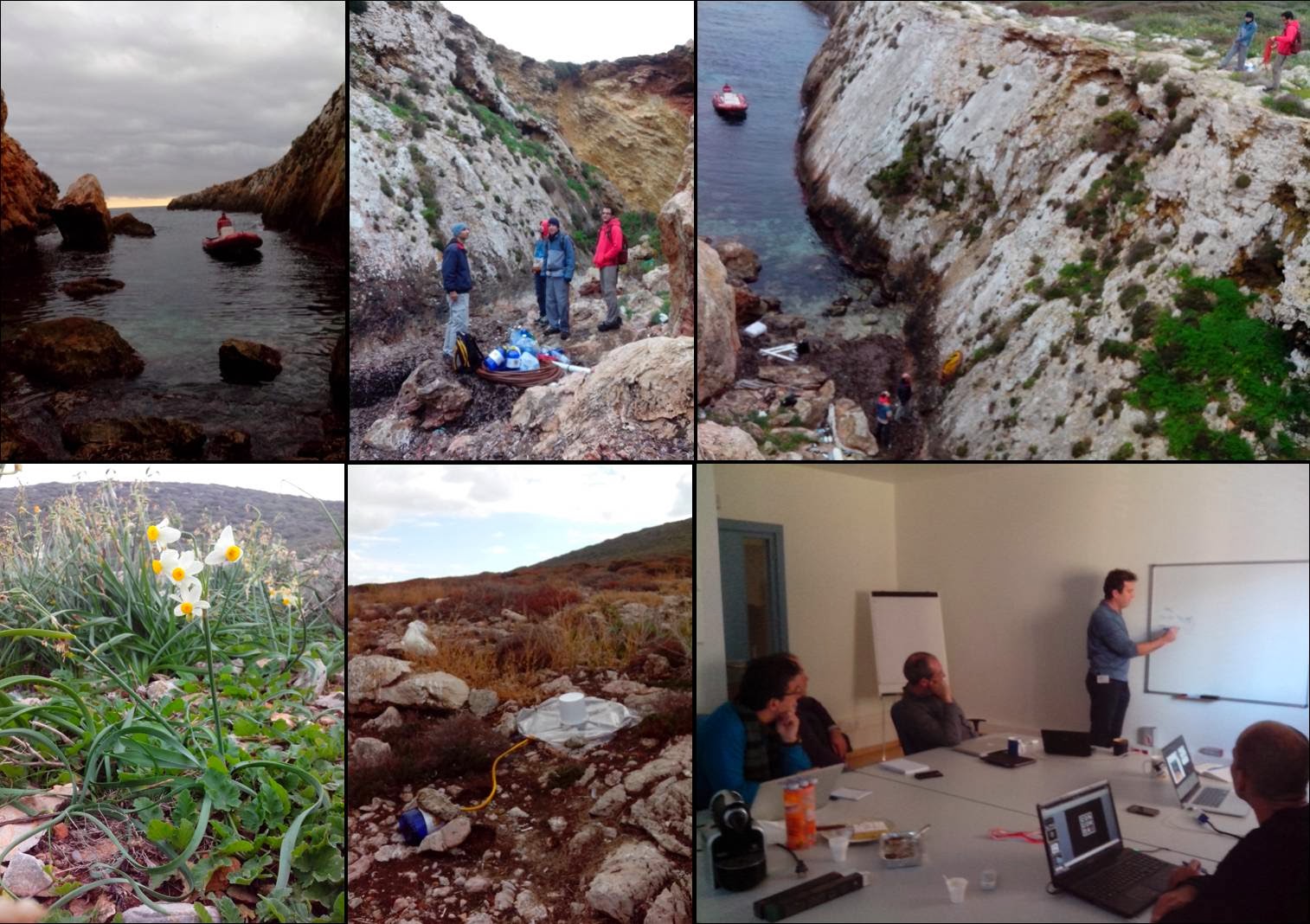
Last week, we joined other members of the Concorda project and sailed into Conillera ("Rabbit Island") to install 55 collectors of seabird guano.

The visit, during which samples of atmospheric deposition from a collector placed at neighboring Cabrera Island were also taken, was a (long-awaited) success: Conillera has no harbour, so we needed almost perfect sea conditions to be able to jump into the rocky shores. Rough terrein demanded also the use of ropes to disembarck the material, and made the transport and installation of the collectors challenging. But we had a perfect winter day, cold and sunny, and enjoyed the exhuberant autumn bloom of local daffodils Narcissus tazzeta.

Two days later, we had the second annual meeting of the Concorda Project - a great opportunity to learn from the diverse expertise of its multidisciplinar consortium.

1.12.13

LSE moves to Sevilla and becomes SEG

Last October 15th, the Laboratory of Spatial Ecology moved to the Doñana Biological Station (EBD-CSIC) at Sevilla (SW Spain), and became the Spatial Ecology Group - which is part of the Department of Wetland Ecology.

We celebrated the move with  a barbecue, where preeminent researchers from EBD showed that they can also do reasonable soccer; and a morning of birdwatching in the marismas -where we enjoyed recently-arrived geese, cranes, waders, resident flamingoes, raptors, and our all-times favourite: ducks.

For a few months, we will be finishing-off existing work projects at Mallorca - and part of the Group's personnel will be based there. And we hope to continue our collaborations with former colleagues at IMEDEA for years to come.


Farewell Mallorca, which was a great place to be and do research - and welcome Sevilla, which will hopefully meet our high expectations!