20.5.15

Special issue on Exploitation Barriers


Evolutionary Ecology


Evolutionary Ecology just published a Special Issue on Pollination Exploitation Barriers, edited by Miguel A. Rodríguez-Gironés (EEZA-CSIC) and Luis Santamaría (SEG, EBD-CSIC). 

We are very excited about the issue, which allowed us to summarize our recent work on exploitaiton barriers and frame it in the context of the reseach developed by other groups across the world.

Have a look at the contents below, with links embedded in case you want to sample some of the papers:


Are flowers red in teeth and claw? Exploitation barriers and the antagonist nature of mutualisms
L. Santamaría, M. A. Rodríguez-Gironés Pages 311-322

Passive partner choice through exploitation barriers
Miguel A. Rodríguez-Gironés, Shan Sun, Luis Santamaría Pages 323-340

Bee- to bird-pollination shifts in Penstemon: effects of floral-lip removal and corolla constriction on the preferences of free-foraging bumble bees
Jessica L. Zung, Jessica R. K. Forrest, Maria Clara Castellanos… Pages 341-354

Convergence of anti-bee pollination mechanisms in the Neotropical plant genus Drymonia (Gesneriaceae)
John L. Clark, Laura Clavijo, Nathan Muchhala Pages 355-377

Diversity and evolution of pollinator rewards and protection by Macaranga (Euphorbiaceae) bracteoles
Eri Yamasaki, Atsushi Kawakita, Shoko Sakai Pages 379-390

The function of ant repellence by flowers: testing the “nectar protection” and “pollinator protection” hypotheses
Francisco G. Gonzálvez, J. Chen, Miguel A. Rodríguez-Gironés Pages 391-403

Nectar palatability can selectively filter bird and insect visitors to coral tree flowers
Susan W. Nicolson, Sara Lerch-Henning, Megan Welsford… Pages 405-417

Long corollas as nectar barriers in Lonicera implexa: interactions between corolla tube length and nectar volume
Amparo Lázaro, Clara Vignolo, Luis Santamaría Pages 419-435

Functional and phylogenetic diversity of plant communities differently affect the structure of flower-visitor interactions and reveal convergences in floral traits
Robert R. Junker, Nico Blüthgen, Alexander Keller Pages 437-450

Are pollinators and seed predators selective agents on flower color in Gentiana lutea?
Tania Veiga, Javier Guitián, Pablo Guitián, José Guitián… Pages 451-464

21.3.15

Invasive species management in the Seychelles


Lucía Latorre, former postgraduate researcher at the Sptial Ecology Group, works currently as coordinator of an invasive species control project at Praslin Island, Seychelles.

Today's article at the newspaper La Región de Ourense (in Spanish) gives us a hint of her work and plans for the near future:

Lucía Latorre, la ourensana que protege el paraíso de las Seychelles


26.11.14

Facilitating transitions towards adaptive governance in the Doñana region


Next Thursday 11th 2014, at 11:00, Pablo Fernández Méndez will defend his PhD Thesis at the Universitat de les Illes Balears (Mallorca).

Pablo's thesis focuses on the need for transitions from command-and-control schemes towards more flexible, participatory and adaptive approaches to policy and decision making: specifically, adaptive governance and adaptive management.

If you are around Palma next month, please feel welcome to join us. If not, you can have a look at Pablo's papers at Ecology & Society and Evolutionary Applications - and keep an eye here for the ones to come.

24.9.14

Space, time and complexity in plant dispersal ecology


A review led by Juanjo Robredo-Arnuncio, in which eight different avenues for the development of plant dispersal research are discussed, has been published in Movement Ecology:


Robledo-Arnuncio JJ, Klein EK, Muller-Landau HC and Santamaría L Space, time and complexity in plant dispersal ecology. Movement Ecology 2014, 2:16

Movement Ecology is a young and thriving journal. It is also open access, so don't miss the chance to have a look at this paper.

28.7.14

High connectivity in European inland-water taxa

A new paper, included in Duarte Viana's PhD Thesis, is now in early view: 

Viana, D., Santamaría, L., Schwenk, K., Manca, M., Hobaek, A., Mjelde, M., Preston, C.D., Gornall, R.J., Croft, J., King, R., Green, A.J., Figuerola, J.(2014) Environment and biogeography drive aquatic plant and cladoceran species richness across Europe. Freshwater Biology.

The paper builds on a survey carried out during EU-project LAKES to show that environmental filters and biogeography, but not dispersal, are the two major drivers of species richness in two major inland-water taxa (waterfleas and aquatic plants) across Europe.

14.6.14

Eggs on ricefields

Spring is coming to an end and, with it, the breeding season of most waders here. But some of them go for a late round of breeding in the rice fields, which were recently flooded and sown.

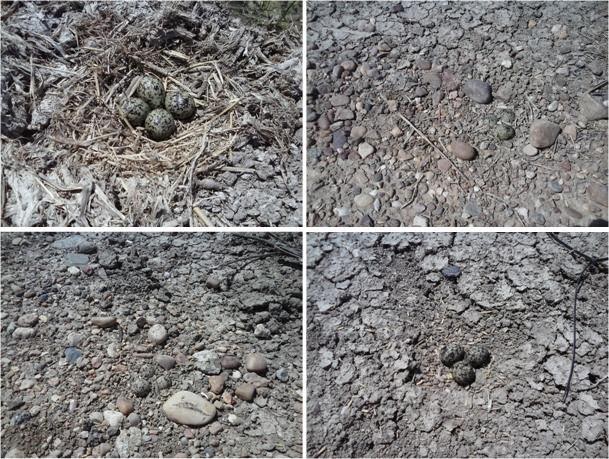
Last week, we joined Jordi Figuerola for field work and found, along the dikes separating the different rice plots, numerous nests of Kentish plover, black-winged stilt and collared pratincoles. They ranged from rudimentary nests to mere excavations on the ground, with eggs rather difficult to spot - even in some of these close-ups.

Can you see them?