3.10.22

Los herbívoros se mueven, pero sus recursos no


(See English version below)

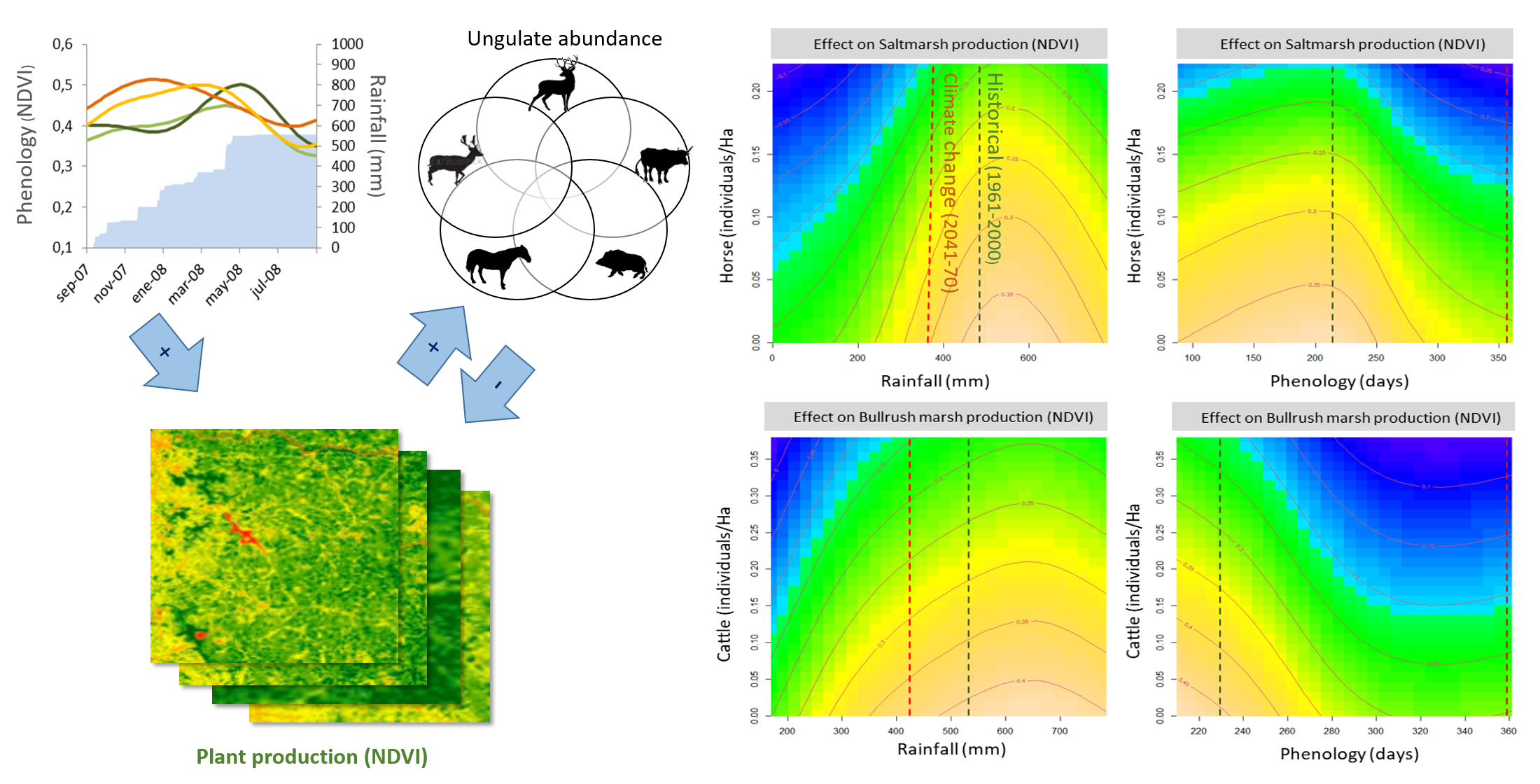
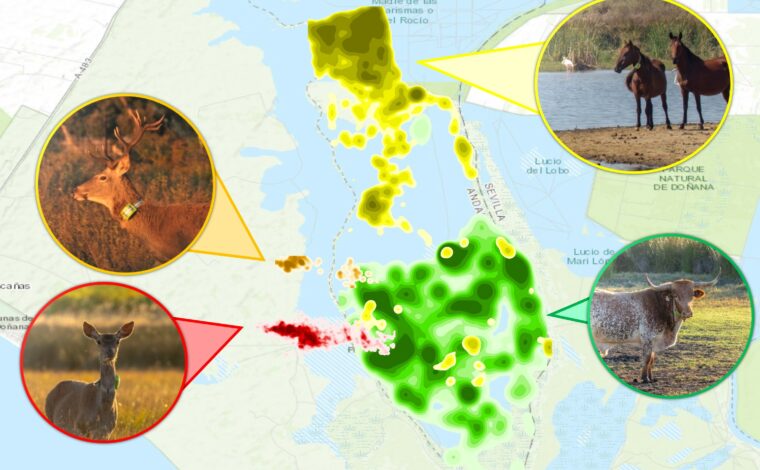
El pasado 30 de setiembre, el equipo del Grupo de Ecología Espacial estuvo presente en la Noche Europea de los Investigadores celebrada en Sevilla, desarrollando la actividad Los herbívoros se mueven, pero sus recursos no: ¿Podemos proteger la vegetación de Doñana ante el cambio climático?

Esta actividad, basada en el trabajo que desarrollamos actualmente dentro del proyecto SUMHAL-WP3 y en los resultados de otros proyectos previos (como el proyecto GRAZE), buscaba familiarizar a los participantes con los ungulados del Parque Nacional de Doñana; presentaba varios ejemplos practicos de las metodologías que usamos para investigar su comportamiento trófico, uso del espacio e interacciones con la vegetación; y mostraba algunos ejemplos de las actuaciones de gestión realizadas para reducir el impacto que genera la sobreherbivoría en este espacio protegido.

--

Last September 30th, a team of the Spatial Ecology Group was present during the European Researcherers' Night in Sevilla. The presented the activity Herbivores move, but their food resources don't: Will we be able to protect Doñana's vegetation against climate change? 

The activity was based on the corrent research undertook by the SUMHAL-WP3 project, as well as in the results of previous research project such as GRAZE. It aimed at familiarizing participants with Doñana's ungulates; presenting the methodologies used to investigate their trophic behaviour, space use and their interactions with the vegetation; and showed several examples of the management measures used to reduce their impact on the vegetation of this iconic protected area.

29.6.22

Extending the seed dispersal effectiveness framework across the mutualism–antagonism continuum

 Details are in the caption following the image

The seed dispersal effectiveness (SDE) framework provides a mechanistic approach to evaluate evolutionary and ecological characteristics of animal-mediated seed dispersal, by synthesising the quantity and the quality of the dispersal that a plant species receives from each of its animal dispersers. However, the application of the SDE framework has been largely restricted to plant–frugivore interactions, whereas animal-mediated seed dispersal results from plant–disperser interactions that cover a continuum from pure mutualisms to antagonisms.

In the article "A seed dispersal effectiveness framework across the mutualism–antagonism continuum", recently published in Oikos, an international team of researchers (including Nacho Villar and Luis Santamaría from the SEG) propose an extended SDE framework aiming at including plant–disperser interactions in the full mutualism–antagonism continuum, ranging from pure mutualisms (frugivores) to conditional mutualisms (scatter-hoarding granivores and folivores) and antagonisms (pure granivores).

Examples used to illustrate how it can be applied to compare effectiveness among plant–disperser interaction types indicate that vertebrate species differ more in the number of seeds they deposit away from the mother plant (quantity), than in the effects such dispersal processes have on seed fate (quality). Scatter-hoarding granivores provide the most effective dispersal due to high removal rates, closely followed by frugivores due to high deposition rates. Folivores and pure granivores provide low quantity dispersal, but of high and moderate quality, respectively. These early comparative insights illustrate the necessity and usefulness of more standardized data collection protocols, for which we provide recommendations. 

Applying the eSDE framework can reveal broad-scale patterns across and within plant–disperser interaction types, which will advance our evolutionary understanding of plant–animal interactions. This will provide new insights into the consequence of anthropogenic impacts on vertebrate-mediated seed dispersal in a world in which plant–animal interactions are increasingly threatened.

Reference: van Leeuwen, C.H.A., Villar, N., Mendoza Sagrera, I., Green, A.J., Bakker, E.S., Soons, M.B., Galetti, M., Jansen, P.A., Nolet, B.A. and Santamaría, L. (2022), A seed dispersal effectiveness framework across the mutualism–antagonism continuum. Oikos e09254. https://doi.org/10.1111/oik.09254

22.10.21

Functional and phenological complementarity among vegetation types increase ecosystem resilience to climate change and grazing


In environments with high climatic variability such as the Mediterranean region, plant primary production shows strong seasonal and inter-annual fluctuations, which both drive and interplay with herbivore grazing. Knowledge on the responses of different vegetation types to the variability in both rainfall and grazing pressure by wild and domestic ungulates is a necessary starting point for the sustainable management of these ecosystems.

We combined a 15 year series of remote sensing data on plant production (NDVI) with meteorological (daily precipitation data) and ungulate abundance (annual counts of four species of wild and domestic ungulates: red deer, fallow deer, cattle, and horses) in an iconic protected area (the Doñana National Park, SW Spain) to  estimate the impact of intra- and inter-annual variation in rainfall and herbivore pressure on primary production, for each of four main vegetation types. 

Our results showed that, although the density of domestic ungulates shows a linear, negative effect on the primary production of three of the four vegetation types, differences in primary production and phenology among vegetation types increase ecosystem resilience to both climatological variability and grazing pressure. Such resilience may be reduced under the conditions predicted by climate change models, if the reduction in rainfall levels is not accompanied by reductions in the densities of domestic ungulates - potentially leading to no-return degradation levels. New management strategies taking advantage of habitat heterogeneity and phenological alternation, more flexible stocking rates, and the redistribution of management units should be considered to mitigate these effects.

This work, belonging to the PhD Project of Juan Miguel Giralt (the leadind author), just got published in the paper: Complementary Differences in Primary Production and Phenology among Vegetation Types Increase Ecosystem Resilience to Climate Change and Grazing Pressure in an Iconic Mediterranean Ecosystem

20.5.21

Grazing under climate change: quantifying the relationship between rainfall, grazing pressure and plant primary production

The GRAZE project has concluded a field experiment combining a factorial combination of:

-        Three rainfall levels: +30%, -30% and control. The -30% reduction coincides with forecasted levels of rainfall decrease under current climate-change scenarios.

-        Six levels of simulated herbivory, using clipping frequencies ranging from biweekly applications (highest level of simulated herbivory) to a last harvest closely after seed production (no-grazing control) .

The experiment was deployed in the mesic grasslands (‘vera’) of the Doñana Biological Reserve. Following an interrupted attempt during the spring of 2020, it was re-started in October 2020 and reached the first final harvest, coinciding with the end of the growth season, on 12-13 May 2021. We plan to extend the experiment three years more, evaluating the long-term, accumulated impact of the different experimental treatments.

  Setup and general view of GRAZE’s ‘rainfall x grazing pressure’ experiment. 


Images from the final harvest of the experiment’s first growth season.


14.11.20

Identifying thresholds of change during the first wave of COVID-19 in Spain


One of the largest nationwide bursts of the first COVID-19 outbreak occurred in Spain, where infection expanded in densely populated areas through March 2020. 

In the article Chasing the ghost of infection past: identifying thresholds of change during the COVID-19 infection in Spain, recently published in Epidemilogy & Infection, we analyzed the cumulative growth curves of reported cases and deaths in Spain, Madrid and Catalonia, and associate identify changes in their growth curve with key events, containment measures,  policy stringency and citizen mobility. 

Results showed four major reductions in growth rates originating from infections before March 3 and on March 5–8, 10–12 and 14–18, but no identifiable effect of the strengthened lockdown of 29–30 March. Changes in stringency and mobility were only associated to the latter two shifts.

These patterns of change show that a combination of public awareness, personal hygiene and social distancing can help slow down COVID-19 spread in future outbreaks – such as the one already ongoing in Spain or Israel in September 2020. They also emphasize that policy implementation should be accompanied by a more effective communication strategy that helps engaging the general public into following measures whose effectiveness can be misperceived due to the long infection-to-detection lags of SARS-CoV-2 infections. 

This virtuous combination of active public health and information policies, and the reinforcement of primary health care would help avoiding the harsh economic and social consequences of having to recourse to hard lockdowns in current and future outbursts of COVID-19 and other pandemics.

You can access the Suppementary Information, not provided yet in the Advanced Onlipe Publication, here.

20.9.20

COVID-19 effective reproduction number during Spain's confinement


COVID-19 pandemic has rapidly spread worldwide, and Spain has suffered one of the largest nationwide bursts, particularly in the highly populated areas of Madrid and Barcelona - two of the five largest conurbations in Europe. 

In the article COVID-19 effective reproduction number dropped during Spain's nationwide dropdown, then spiked at lower-incidence regions (for which the journal offers now a 50 days' free access), Luis Santamaría and Joaquín Hortal used segmented regression analyses to identify shifts in the evolution of the effective reproduction number (Rt) reported for 16 Spanish administrative regions - qand associated the observed breaking points with a timeline of key containment measures taken by national and regional governments, applying time lags for the time from contagion to case detection.

Results show an early decrease of Rt that preceded the nationwide lockdown; a generalized, sharp decrease in Rt associated with such lockdown; a low impact of the strengthened lockdown, with a flattening of Rt evolution in high-incidence regions, and even increases in Rt at low-incidence regions; and an increase in Rt associated to the relaxation of the lockdown measures in ten regions. 

These results evidence the importance of generalized lockdown measures to contain COVID-19 spread, and the limited effect of the subsequent application of a stricter lockdown (restrictions to all non-essential economic activities). Most importantly, they highlight the importance of maintaining strong social distancing measures and strengthening public health control during lockdown de-escalation. 

Failing to fulfill these requirements has thrown Spain into a new cycle of  widespread, uncontrolled infections - particularly at Madrid. This article aimed therefore to be one of the numerous contributions to lay down a  robust sicentific base for mor efficient policies to dealing with the COVID-19 pandemic.